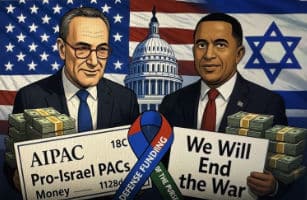
The Same Leaders Who Cashed the Checks Now Want to End the War
Voters just handed Democrats the House and the Senate. The first message from Chuck Schumer and Hakeem Jeffries was not about borders, debt, or the price of gas. It was that they would end the war with Iran. Schumer put it bluntly: “We are going to end the war.” He pointed to the power of the purse. Jeffries called the Iran conflict a “reckless and costly war of choice” and said ending it should be a top priority, preferably before the new Congress even takes office. Americans have felt the costs. Energy prices jumped. Families paid more at the pump. Service members were committed without a clear, stable explanation of the objective. Those facts helped drive the midterm result. The question is whether Schumer and Jeffries are applying a consistent standard or simply discovering the Constitution’s tools after an election loss.
The public record shows a different pattern. OpenSecrets lists roughly $1.73 million in career contributions to Schumer from pro-Israel sources. Trackers based on FEC filings put Jeffries in the same neighborhood: more than $1.4 million from AIPAC PAC, United Democracy Project, and related pro-Israel vehicles, much of it earmarked individual money routed through the PAC. AIPAC has endorsed Jeffries. Both men supported major supplemental packages that sent billions in military assistance to Israel.
Schumer has been open about the priority. He has said one of his jobs is to fight for “all the aid that Israel needs.” He opposed measures to block specific arms sales or cut the annual Foreign Military Financing. Jeffries’s record is not uniform on every procedural vote, but he has backed the core aid measures and has not led efforts to condition or reduce the underlying commitment. The same leaders now promising to restrain spending spent years sustaining the funding structure that keeps the United States deeply engaged in the region.
Republican policy under Trump treated Israel as a strategic ally against Iran. The embassy move, the Abraham Accords, and repeated statements of support reflected that view. Most Republican voters still hold it. America First does not require abandoning that relationship. It does require noticing when Democratic leaders who accepted substantial pro-Israel political money and voted for the packages suddenly treat the power of the purse as urgent only after voters rejected the opposing party.
The Iran operations raised real costs for Americans. Gas prices rose. The justification shifted. Those effects were measurable and politically decisive. Congress does possess the tools to constrain unauthorized or open-ended military action. The difficulty is the timing. The same power of the purse was available while these leaders supported multi-billion-dollar packages that included Israel aid. It was available while both men maintained “ironclad” language on the U.S.-Israel relationship and while Schumer described preventing an Iranian nuclear weapon as a top priority. It became the central message only after Democrats won the majority.
Some Republicans had already joined Democrats on certain war-powers resolutions. That undercuts any claim that the issue is purely partisan. If the principle is that costly, poorly explained wars should be constrained by Congress, the principle should not activate only when the other party holds the White House. Voters who care about energy prices, debt, and avoiding open-ended commitments can ask whether the new majorities will apply the same scrutiny to other spending or only to the conflict that proved useful in the midterms.
The numbers are in the FEC filings and OpenSecrets summaries. The post-election statements are on the record. Comparing them does not require treating support for Israel as illegitimate. It requires recognizing that leaders who took the money and backed the aid are now presenting themselves as the ones who will finally restrain foreign military spending. America First means the American interest is the decisive variable. The next several months will show whether the power of the purse is a consistent tool or a post-election slogan. The funding record and the voting record already indicate which version is more likely.