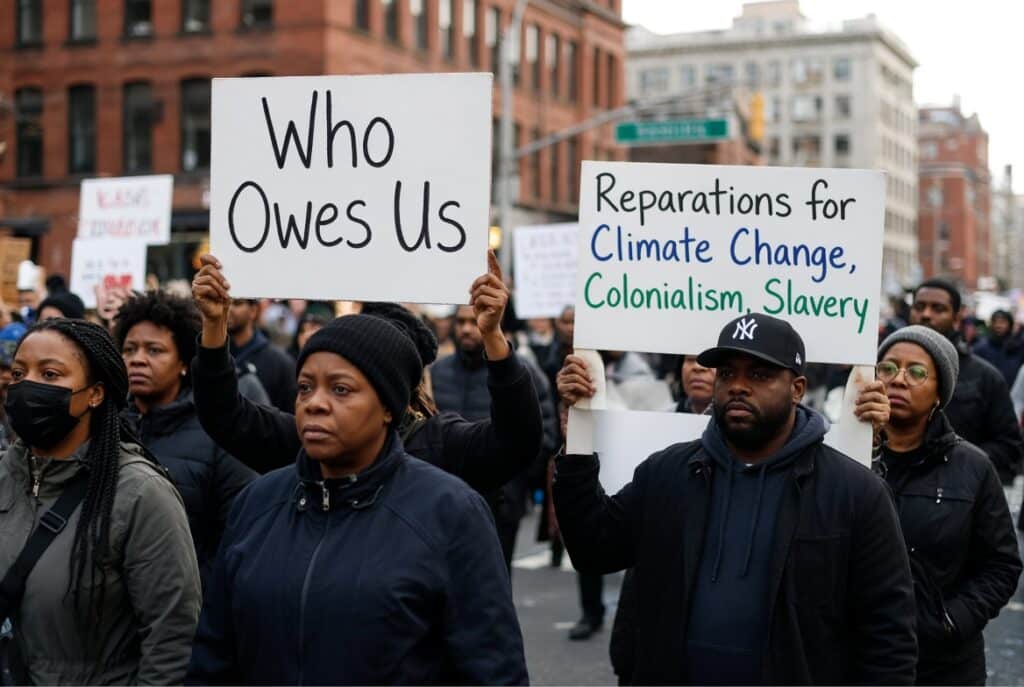
Texas Bill Establishes a Freedman’s Bureau and Reparations
Texas State Senator Borris Miles filed legislation, SB376. It establishes, or should I say re-establishes, a Texas Freedman’s Bureau. It is a new bureaucracy. Its purpose is to help descendants of enslaved people obtain ancestry ID cards. They can use the cards to collect reparations. What will this card buy? It is an open question.
The original Freedman’s Bureau existed from 1865 to 1870. It helped African Americans displaced by the Civil War.
This 2027-28 bill will attach the bureau to HHS. A Health Commissioner and five commissioners appointed by the governor will oversee it. According to the requirements of the bill, people descended from slaves will be called “freedmen” in all demographic data.
Excerpt 1
Sec. 473.002. ESTABLISHMENT OF BUREAU. The Texas
Freedman’s Bureau is established to assist the residents of this
state in determining their ancestry and heritage, provide
assistance to residents who are certified descendants of freedmen,
and promote the use of the term “freedmen” in demographic data
collected in this state.
Excerpt 2
Sec. 473.104. OFFICES. The bureau shall maintain an office
within facilities of the Health and Human Services Commission and
other state agencies, as appropriate, in the following counties:
(1) Bexar County;
(2) Dallas County;
(3) Harris County; and
(4) Travis County.
Excerpt 3
SUBCHAPTER C. POWERS AND DUTIES
Sec. 473.201. GENERAL POWERS AND DUTIES. The bureau shall:
(1) establish and maintain a database to collect
demographic data for the purpose of assisting residents of this
state in establishing ancestral ties with freedmen;
(2) provide a freedmen identification card to each
resident who establishes ancestral ties with a freedman;
(3) assist residents who are descendants of freedmen
with obtaining reparations, including by providing legal
assistance with filing claims for reparations; and
(4) promote the use of the term “freedmen” for
descendants of freed slaves in all demographic data related to
ethnicity, nationality, or race collected by a state agency or
political subdivision.
Caroline Powell, Chair of the Texas Conservative Party, outlines a historical picture.
- In 1819, under President James Monroe, Congress authorized $100,000 to support returning Africans who wished to return to Africa. The American Colonization Society later established Monrovia, Liberia, with U.S. support, paid for by Americans. The American Colonization Society acquired land in West Africa in 1821, with U.S. Navy involvement. Free Black Americans and formerly enslaved people emigrated there. That history deserves to be part of this discussion.
- The 14th Amendment guarantees equal protection of the laws. Texas Constitution, Article I, §§3 and 3a, protects equality under state law. Would ancestry-based government benefits survive constitutional scrutiny?
- Rice v. Cayetano (2000), the US Supreme Court recognized that ancestry can operate as a proxy for race. That case concerned voting rights, but its constitutional reasoning raises serious questions about ancestry-based classifications.
- Native Indians suffered unlawful land seizures. Irish immigrants suffered as indentured servants who were treated much worse. Black Americans were murdered and terrorized by the KKK (founded by the Democrat Party, and you have to be in the Democrat Party to be a member).
- If reparations programs are established, what consistent legal standard determines eligibility and government responsibility?
- Reparations have been paid and are in the past. Who will pay reparations to all of the children who are taken and sold into sex slavery today? Why are we ignoring what is happening today?
- The historical records also show that colonization was controversial. Not all African Americans wished to leave the United States. The government then established the 1865 land-allocation efforts commonly called “40 acres and a mule.”
Read SB00376I here or here.
Image: AI Grok